There is a sub-genre in fantasy that focuses mainly on female protagonists. Robin Mckinley. Patrica McKillip. Julliet Marillier. Sharon Shinn. Ellen Kushner. They each feature a feminine prospective in a genre that is usually riddled with long lost kings and brutal battle scenes. What is interesting is the different prospectives they give and the subtle ways they show them.
Robin Mckinley's protagonists are usually very straight forward female heroes. They wield swords along side men and stand up for their gender in the face of oppression. Her heroines are proud of being women and make sure everybody knows it. This used to annoy me. A lot. When I was young and didn't realize that gender equality wasn't self evident to everyone in the world. Now I sometimes wish her heroines would relax and just be without having to prove their independence to everybody all the time but I also understand that, especially in the context of a pseudo medieval society, that isn't always an option.
Patrica McKillip is almost the opposite. I have never encountered anything resembling gender inequality in her books. She has equal female and male characters who fight battles and rule kingdoms and play music together without ever thinking anything of it. Rather than fighting against oppression her heroines serve as an example simply by living in an idyllic world where no one has ever suggested that one gender is more important or able than the other. There might be certain social expectations but even those are seldom strongly enforced.
Julliet Marillier's characters are feminists in a way that took me a book or two before I recognized it as such. Rather than fight against expectations or live in a world where they don't exist, Marillier's characters are content to be domestic and nurturing. These skills are painted, however, in such a way that they are revered rather than looked down on. Her characters recognize that their roles are just as important as the "great deeds" performed by the men and are able to unlock secrets and magic everyone else might over look.
Ellen Kushner takes yet another approach. Her male and female characters tear down the constrains of both gender roles. Within the context of a very strict society her male and female characters fuss over silk and wield swords simultaneously.
I know that over all good characterization is more important than a "positive" feminine --or male --image but when I'm working with a historical society that enforces unfair expectations I am reluctant to allow them to get away with it. On the other hand I want the setting to remain authentic without too much modern thinking infiltrating its way into my characters' heads. I strive for a balance but I think I ere on the side too much modern thinking more often than too much accuracy.
What about you? Do you ever wonder about how you are representing gender in your manuscripts? Have you noticed any other ways authors deal with it? Or do you only worry about character and let any gender issues that arise take care of themselves?
Showing posts with label Patricia McKillup. Show all posts
Showing posts with label Patricia McKillup. Show all posts
Monday, May 9, 2011


Friday, April 22, 2011
S: Selkies
A selkie is a seal shape shifter from celtic folk lore. The selkie sheds its skin and becomes human, usually to get married. Unless their spouse keeps the skin hidden from them, however, they soon sucomb to their longings to return to the sea and abandon their family.
Movies featuring selkies:
Ondine

The Secret of Roan Inish

Books featuring selkies:
Worfskin by Julliet Marillier

Foxmask by Julliet Marillier

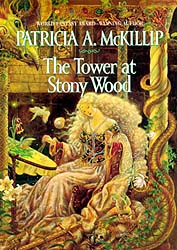
Tower at Stony Wood by Patricia McKillip

Movies featuring selkies:
Ondine
The Secret of Roan Inish

Books featuring selkies:
Worfskin by Julliet Marillier

Foxmask by Julliet Marillier

Tower at Stony Wood by Patricia McKillip
Saturday, April 16, 2011
M: McKillip

Of all the authors I could read over and over and never be tired of, Patricia McKillip is on the top of the list. Her newest book, The Bards of Bone Plain, did not in any way disapoint me. Her prose is so rich, abuntant with feeling and imagery. She creates music with her words that you can feel in your bones.
The story of The Bards of Bone Plain centers, of all things, around the research of a term paper of young scholar, Phelan Cle. This is a McKillip world however, so even though the time era (if there is such a thing as time in her books) is something similar to Edwardian, bards still play at court and even something as mundane as chronologuing the life of a dead poet is clouded in magic and mystery. In fact, on closer imspection it is the simplest things that contain the most magic. The past quickly merges with the present as Phelen begins to unravel them both.
Even more than her astonishing style, what makes McKillip's books seem so much like poetry is that they exist in a place that follows no rules. Musicians compete for the position of royal bard with songs drawn from their bones while the queen throws garden parties and the princess drives her automobile to an archeological site to dig up ancient tombs. Anything can exist and yet the world winds around itself, so inctricately connected, so vivid and tantilizing that the reader never for a moment questions.
Other favorites by Patricia McKillip:
Alphabet of Thorn

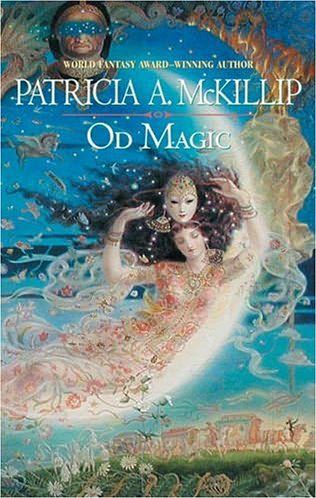
Od Magic
Song For the Basilisk

The Forgoten Beasts of Eld
In the Forests of Serre

Note also the beautiful book covers by Kinuko Kraft. No one else could fully capture the mood of these books.
Wednesday, August 18, 2010
Quotation is a serviceable substitute for wit --Oscar Wilde
"I am an artist . . . and therefore a liar. Distrust everything I say. I am telling the truth."
--Ursula LeGuiun
"He taught me the difference between everything and nothing"
"Which is?" Vevey prompted, looking baffled
"Words."
---Patricia McKillup, Alphapet of Thorn
"The wrong words. They were true a hundred times over, yet they sounded like a lie. Hadn't he always know it? Words were useless. At times they might sound wonderful, but they let you down the moment you needed them. You could never find the right words. Never, and where would you look for them? The heart is as silent as a fish, however much the tongue tries to give it a voice."
--Cornelia Funke, Inkspell
"A dreamer is one who can only find his way by moonlight, and his punishment is that he sees the dawn before the rest of the world."
--Oscar Wilde
There are worse crimes than burning books. One of them is not reading them.
--Ray Bradbury
All that I desire to point out is the general principle that life imitates art far more than art imitates life.
--Oscar Wilde
You must stay drunk on writing so reality cannot destroy you.
--Ray Bradbury
If the writing is honest it cannot be separated from the man who wrote it.
--Tennessee Williams
There is nothing to writing. All you do is sit down at a typewriter and bleed.
--Ernest Hemingway
Even in literature and art, no man who bothers about originality will ever be original: whereas if you simply try to tell the truth (without caring twopence how often it has been told before) you will, nine times out of ten, become original without ever having noticed it.
--C. S. Lewis
"For while the tale of how we suffer, and how we are delighted, and how we may triumph is never new it always must be heard. There isn't any other tale to tell, its the only light we got in this darkness."
--James Baldwin
It is a good thing for an uneducated man to read books of quotations.
--Winston Churchill
--Ursula LeGuiun
"He taught me the difference between everything and nothing"
"Which is?" Vevey prompted, looking baffled
"Words."
---Patricia McKillup, Alphapet of Thorn
"The wrong words. They were true a hundred times over, yet they sounded like a lie. Hadn't he always know it? Words were useless. At times they might sound wonderful, but they let you down the moment you needed them. You could never find the right words. Never, and where would you look for them? The heart is as silent as a fish, however much the tongue tries to give it a voice."
--Cornelia Funke, Inkspell
"A dreamer is one who can only find his way by moonlight, and his punishment is that he sees the dawn before the rest of the world."
--Oscar Wilde
There are worse crimes than burning books. One of them is not reading them.
--Ray Bradbury
All that I desire to point out is the general principle that life imitates art far more than art imitates life.
--Oscar Wilde
You must stay drunk on writing so reality cannot destroy you.
--Ray Bradbury
If the writing is honest it cannot be separated from the man who wrote it.
--Tennessee Williams
There is nothing to writing. All you do is sit down at a typewriter and bleed.
--Ernest Hemingway
Even in literature and art, no man who bothers about originality will ever be original: whereas if you simply try to tell the truth (without caring twopence how often it has been told before) you will, nine times out of ten, become original without ever having noticed it.
--C. S. Lewis
"For while the tale of how we suffer, and how we are delighted, and how we may triumph is never new it always must be heard. There isn't any other tale to tell, its the only light we got in this darkness."
--James Baldwin
It is a good thing for an uneducated man to read books of quotations.
--Winston Churchill
Subscribe to:
Posts (Atom)