Showing posts with label Robin Hood. Show all posts

Monday, February 21, 2011

In Which I Rant About the 2010 Robin Hood Film


Reasons for seeing this film:

1. It has a beautiful soundtrack.

2. I like that it ends with Robin going into the woods instead of coming out of them. The traditional outlaw becoming an Earl is supposed to be a 'Happy ever after' ending but it is much more satisfying to see the legend begin than to see it end.

Reasons for not seeing the film:

1. Robin is too serious. And too old. In all the ballads Robin Hood is young and spritely. An impudent youth who gets the better of “the man”. A poor man's incantation of the Trickster God. Of all the films I've seen this is the one in which his character stays most true to the spirit of the legend:


2.Maid Marian is married. Before she was attached to the Robin Hood legends Maid Marian was the Queen of the May Games. It is odd, I suppose, that fertility was celebrated with the glorification of virginity. That would be an interesting theme to explore in a retelling of Robin Hood but she is meant to be Robin's “virgin bride”, waiting until he is no longer outlawed to be with him. Can that be changed? Of course. Unaddressed? No.

3. King Richard is dead. I understand that this is the “historical version”. I have my theories on that since history can become as much a collaboration of various traditions as legends. Nonetheless it has come to the recent attention of history books that king Richard I wasn't quite so heroic as Sir Walter Scott made him out to be. I'll grant that this is true. I'll also grant that if the film makers were to place the story during the Coer de Lion's absence to the “Holy Wars”, as is tradition, Robin would only have reign of the woods for three or four years, his 'happy ever after' with Richard actually ruling England would last less than one year, and before Robin had a chance to die John would be legally on the thrown where nothing could be done about it. My question then is if the film makers wished to go through so much trouble to break away from tradition and keep things “historical” why set the story in the 1200s at all? Documentation of the Robin Hood legends didn't turn up until the mid 1300s. That was also when the English Long Bow was invented, the term –and really class of –yoeman took form, and the poaching of deer and danger of outlaws became a major issue in Sherwood and Barnesdale. The only mention of a king's name in any of the ballads was a King Edward and Edward IV made a trip to Sherwood and Barnesdale during that time.

4. The plot itself. Awkward is the word I will use here. Or maybe undirected. I never got the sense of a real climax or even much of a journey. Robin begins fighting in France for King Richard in which there is a long battle scene with no particular character development and ends with a long battle against French soldiers in England with no particular character development. The difference, I think, is supposed to be that he believes in this fight because he is protecting his home instead of invading someone else's. I just don't feel like the events in between adequately lead up to that idea. There are a couple scenes involving him realizing that he was born in Barnesdale and remembering some things his father told him about not giving up but its not enough. He hasn't changed enough to have grown into the legend he is about to become.

One day someone will make a really good Robin Hood movie. Until then I will watch DVDs of this entirely unhistorical fiftiesified Richard Greene show
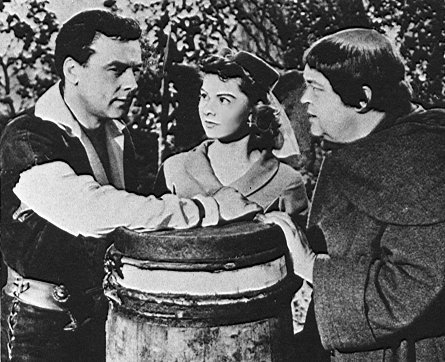

and whistle this tune

Thursday, April 29, 2010

Who is Robin Hood!

Who is Robin Hood? One of the books I’ve been researching for takes place in the late thirteenth century and has (theoretically because I can never say exactly where a book will go) quite a bit of Robin Hood in it, so this is a question I need to answer. I will not ask myself who WAS Robin Hood. Robin Hood WAS (if he even existed) some poor bloke who stole in order to survive. He might have been noble. He could have been driven to it by the injustice of feudalism. He may even have lived during the reign of Ceor de Lion. We’ll never know. Whoever that man was he has evolved into something so much bigger, so much vaguer and so much more true since his death. He has become a legend.

Legends evolve. They are retold so many times, collecting new details and shedding others that no one remembers where they came from or which of the details are fact.

I say fact, not truth. All legends are true in some way or another. Sometimes truer than fact. Legends are in many ways the personification of truths (oh yes, I’m very big into metaphysics. You’re just gonna have to get used to it). They tell us about their storytellers if nothing else. Studying the evolution of Robin Hood I have watched him go from bold but violent yeoman to disinherited nobleman to champion of the people to champion of the king. It all depends on who is telling the story.

Many things have become “Robin Hood” from mere repetition. One storyteller added in a detail and the others liked it and used it again. Listeners grew used to hearing it and it became part of the hero’s tradition. It has become a trend with recent authors get rid of these traditions in order to make the character seem more “real” or “fresh”. I do not like this trend.

The reason we are still telling stories about Robin Hood seven hundred years after his (possible) death is as difficult to pin-point as the man himself. Because he defied authority? Because he was noble at heart? Because he represents a kind of hope for the oppressed? Who knows? Perhaps simply because he can be so ambiguous. Nothing about him is set in stone and yet there are traditions that have become a part of his legend. We hear of a bugle horn sounded in Sherwood and know that he will be along soon. We see some greedy merchant from Nottingham set off down the road and know what his fate will be. True, it is predictable but it is part of the life of Robin Hood that he breathes on his own even without a story to place him in. Deliberately pulling away from these images seems to take some life out of the legend. When we retell his story we are not simply retelling one man’s story. We are retelling thousands of people’s stories as they told them from generation to generation.

So who is Robin Hood? I have no idea. He can’t be everything that legend calls him. A yeoman and a disinherited lord? A man who lived during the reign of King Edward (which ever one) and King Richard? He married the shepherdess Clorinda? He married the queen of the May games? He worked for the king of the fairies? He is loyal to the king? He leads a rebellion? I must choose which traditions work best for my story.

Does that mean I am doing the same thing as all those “modern authors” who so annoy me? Will the legend be shedding other people’s stories in order to make way for my own? Will he even be “Robin Hood” at all or just some new character with the same name? I guess the only question I can really ask is who Robin Hood is to me. I can hope some residue of the legend still clings to my version but I can’t tell everyone’s story.